Best Graphing Calculator for ACT: 9 Picks in 2026

The ACT creates a particular calculator problem. Many questions can be handled with a basic scientific calculator, yet a graphing model may be useful for checking functions, comparing values, and working through algebra more visually during preparation. The catch is that a graphing calculator can become a distraction if its menus are unfamiliar, its screen is hard to read, or your testing location has different rules for permitted models.
For this guide, the useful distinctions are practical. A color display can help separate plotted functions, textbook-style notation can make fractions easier to read, and a streamlined keypad may reduce menu hunting during practice. Battery design, graphing tools, statistical functions, and any stated ACT-related claim also matter, but product capability and current exam permission are separate questions. Check the exact calculator policy before test day.
The Texas Instruments TI-84 Plus CE is the strongest overall fit because it combines color graphing, MathPrint notation, a rechargeable battery, and a familiar feature set for ACT preparation. Buyers seeking a lower-cost route, a larger feature range, or MicroPython support may find the Casio fx-9750GIII, Casio Prizm FX-CG50, or TI-Nspire CX II more suitable.
Quick Answer
- Best Overall: Texas Instruments TI-84 Plus CE Color Graphing Calculator for color graphing, textbook-style notation, and rechargeable convenience.
- Best for Streamlined Navigation: TI-84 Evo Graphing Calculator for its icon-based home screen, larger buttons, and expanded graphing area.
- Best for 3D Graphing: Casio Prizm FX-CG50 Color Graphing Calculator for color graphing, 3D functions, and MicroPython support.
- Best Budget-Oriented Option: Casio fx-9750GIII Graphing Calculator for graphing, statistics, probability distributions, spreadsheets, and MicroPython.
Best Graphing Calculator For ACT Comparison Table
| Product | Best For | Notable Features | Power or Software |
|---|---|---|---|
| TI-84 Plus CE | Best overall ACT preparation | Color graphing, MathPrint | Rechargeable battery, online calculator subscription |
| TI-84 Evo | Streamlined navigation | Icon-based home screen, larger graphs | Listing states faster processor |
| Casio Prizm FX-CG50 | 3D graphing and visual work | Color display, 3D functions | MicroPython, PC transfer |
| TI-83 Plus, Renewed | Traditional graphing on a tighter budget | Split graph and table view, matrices | Fourteen zoom features |
| TI-Nspire CX II | Connected visualizations | High-resolution color display | Rechargeable battery, 4-year software license |
| CATIGA CS-229 | Low-cost graphing functions | Graph and formula display, 360+ functions | Protective case, solar and battery details not clearly specified |
| Casio fx-9750GIII | Graphing, statistics, and MicroPython | Probability distributions, spreadsheets | USB file transfer |
The reviews below focus on the differences that matter during ACT preparation, from notation and graph visibility to learning curve, advanced tools, and uncertainty around exam rules.
1. Texas Instruments TI-84 Plus CE Color Graphing Calculator, Black: Best Overall

The TI-84 Plus CE fits ACT preparation well because its feature set is broad without being centered on a specialized programming environment. MathPrint lets users enter and view mathematical symbols, formulas, and stacked fractions in a textbook-like layout. That can make a practice session less about decoding a cramped line of symbols and more about checking the actual relationship on the page.
Color graphing gives separate functions more visual distinction, which can help during algebra and function review. The supplied information also identifies a rechargeable battery with a stated runtime of up to one month on a charge, plus a four-year subscription for the TI-84 Plus CE online calculator. Those extras may be useful during homework and preparation, although the handheld and online versions should not be treated as interchangeable for testing.
Pros
- Color display supports visual separation of plotted functions.
- MathPrint shows stacked fractions and formulas in textbook-style notation.
- Rechargeable battery is stated to last up to one month per charge.
- Four-year online calculator subscription is included.
- Suitable for math and science work from middle school through college, according to the product information.
Cons
- The listing does not identify detailed graphing modes or advanced symbolic capabilities.
- Current ACT calculator rules still need to be checked for the exact model.
This model makes the most sense for a student who wants a conventional graphing workflow with clearer notation and color support. A buyer focused on 3D graphing or MicroPython may prefer the Casio Prizm FX-CG50, while someone who wants a more computer-like environment may prefer the TI-Nspire CX II.
To buy this product, click here.
2. TI-84 Evo Graphing Calculator: Best for Streamlined Navigation

The TI-84 Evo takes a familiar TI-84 direction and puts its main emphasis on access. The icon-based home screen places popular math tools in a more visible arrangement, while the simplified keypad uses larger buttons and less visual clutter. For ACT practice, that can matter during short drills where a student wants to move between graphing and calculation without digging through as many layers of menus.
The supplied specifications state that the model has a processor delivering three times faster performance and 50 percent more graphing space. Those are listing claims rather than independently verified measurements, so they should be read as published positioning. The practical appeal is clear, however: a larger graphing area may make patterns easier to inspect, while the navigation changes may reduce the friction of repeated practice.
Pros
- Icon-based home screen puts popular tools in a visible location.
- Larger buttons and reduced keypad clutter are listed as core design features.
- Published information states 50 percent more graphing space.
- Published information states a processor with three times faster performance.
- Built for everyday classroom use according to the product description.
Cons
- The listing does not clearly specify battery type, charging method, or runtime.
- Detailed mathematical functions beyond the listed graphing tools are not identified.
Choose the TI-84 Evo if navigation and graph visibility matter more than programming or specialized graphing features. The TI-84 Plus CE provides clearer supplied information about color and rechargeable power, while the Casio fx-9750GIII offers explicitly listed statistics, probability, spreadsheets, and MicroPython.
To buy this product, click here.
3. Casio Prizm FX-CG50 Color Graphing Calculator: Best for 3D Graphing
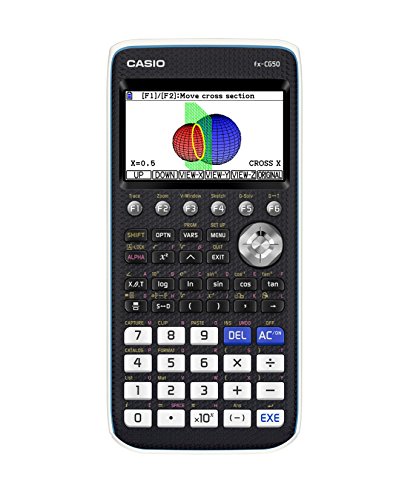
The Prizm FX-CG50 is the most visually specialized option in this group. Its high-resolution color LCD is listed as supporting more than 65,000 colors, and the calculator can support up to three 3D functions such as spheres, cylinders, and planes. That capability reaches beyond the typical ACT calculation need, yet it can be useful for a student who wants one calculator to continue into broader math exploration.
Casio also lists complex numbers, polar and rectangular graphing, simultaneous equations, dynamic graphing, statistics, and geometry. Natural Textbook Display presents expressions and results in a textbook-like form, while MicroPython programming and PC transfer add a separate technical pathway. These features create room for advanced work, though they may be more than a student needs for ordinary ACT practice.
Pros
- Color display is listed with more than 65,000 colors.
- Supports up to three listed 3D functions, including spheres and planes.
- Includes complex-number, polar, rectangular, dynamic, statistical, and geometry tools in the supplied description.
- Supports MicroPython programming and PC transfer.
- Natural Textbook Display presents expressions and results in familiar notation.
Cons
- Its 3D and programming features may be unnecessary for a buyer focused only on ACT preparation.
- The product information does not clearly specify battery type or runtime.
This calculator suits students who want substantial room beyond basic test preparation, especially for visual mathematics and introductory programming. A simpler TI-84 model may involve less feature overhead for routine practice, while the Casio fx-9750GIII offers a more budget-oriented route with several explicitly listed statistics tools.
To buy this product, click here.
4. Texas Instruments TI-83 Plus Graphing Calculator, Renewed: Best for Traditional Graphing

The renewed TI-83 Plus is a straightforward choice for someone who wants established graphing tools without moving into a newer color model. Its split-screen feature can show a graph and table together, allowing a user to trace a curve while scrolling through corresponding values. That relationship between visual shape and numerical output is useful during algebra and function review.
The supplied information also lists calculus, engineering, trigonometric, and financial functions, storage and analysis for up to 10 matrices, and 14 interactive zoom features. Its 64 by 96 pixel LCD is more basic than the color displays in this guide, so the attraction is the conventional toolset rather than visual polish. Because this is a renewed product, the exact condition and included items should be checked before purchase.
Pros
- Split-screen graph and table view supports function-value comparisons.
- Lists calculus, engineering, trigonometric, and financial functions.
- Stores and analyzes up to 10 matrices according to the product information.
- Includes 14 interactive zoom features.
- 64 by 96 pixel LCD specification is clearly provided.
Cons
- The renewed condition makes item condition and included accessories worth checking carefully.
- Its listed monochrome 64 by 96 pixel display is less visually rich than the color models here.
This model is a reasonable fit for buyers who value the familiar TI-83 workflow and graph-table relationship. Students who want color, rechargeable power, or newer interface features should look toward the TI-84 Plus CE or TI-84 Evo instead.
To buy this product, click here.
5. Texas Instruments TI-Nspire CX II Color Graphing Calculator: Best for Connected Visualizations

The TI-Nspire CX II occupies a more computer-like lane than the conventional TI-84 models. Its high-resolution full-color display is described as connecting multiple visualizations of the same concept, which can help a student relate a graph to other representations during extended study. That approach may be especially appealing during preparation sessions where understanding a function matters as much as producing a result.
The product includes a long-lasting rechargeable battery and a four-year license for computer software. Internet access is not required for the handheld according to the product information. This combination gives the calculator a broader study environment, but it can also be more capability than a student wants for short ACT drills. The listing makes exam-related claims, yet current rules should be verified independently for the exact model.
Pros
- High-resolution full-color display is listed.
- Connects multiple visualizations of the same mathematical concept.
- Includes a rechargeable battery according to the product information.
- Four-year computer software license is included.
- Handheld use does not require internet access according to the listing.
Cons
- The computer-like feature set may be more elaborate than necessary for basic ACT preparation.
- The listing does not identify detailed graphing modes or CAS functionality.
The TI-Nspire CX II is most useful for students who want a connected visual study environment and expect to use the calculator beyond a single exam. The TI-84 Plus CE is a more direct recommendation for a familiar keypad-and-graph workflow, while the Casio models provide explicitly listed MicroPython options.
To buy this product, click here.
6. CATIGA CS-229 Scientific Calculator With Graphic Functions: Best Budget-Oriented Option

The CATIGA CS-229 is included because its product information clearly describes actual graphic functions rather than ordinary scientific calculation alone. It supports plotting functions, analyzing graphs, and displaying graphs alongside formulas. For a student who wants a lower-cost way to practice the relationship between an equation and its curve, that combination is more relevant than a standard two-line scientific calculator.
The listing also identifies more than 360 functions, including fractions, complex numbers, statistics, linear regression, standard deviation, and variable solving. Its stated 7 by 3.3 inch body, protective case, and anti-drop design emphasize portability. The exact depth of its graphing modes and battery system is not clearly specified, so buyers should keep expectations focused on the listed functions rather than assuming parity with a TI or Casio graphing platform.
Pros
- Product information explicitly describes function plotting and graph analysis.
- Displays graphs and formulas simultaneously according to the listing.
- Lists more than 360 functions.
- Includes complex numbers, statistics, regression, and standard deviation tools.
- Protective case and anti-drop body are identified in the product description.
Cons
- Detailed graphing modes and the battery system are not clearly specified.
- The listing does not establish the same software ecosystem or course familiarity as the TI and Casio models.
This model suits a buyer who needs graphing functions at a lower stated price range and is willing to verify course expectations independently. A TI-84 Plus CE is a safer fit for a familiar mainstream workflow, while the Casio fx-9750GIII gives more explicitly described educational and programming tools.
To buy this product, click here.
7. Casio fx-9750GIII Graphing Calculator: Best for Statistics and MicroPython

The fx-9750GIII brings together graph plotting and a useful collection of statistics-oriented tools. The supplied information names probability distributions, spreadsheets, vectors, integrals, and eActivities, while Natural Textbook Display presents expressions and results in a familiar format. For ACT preparation, the value lies less in owning every possible feature and more in having a calculator that can continue into statistics and broader math courses.
MicroPython support gives this model a distinct identity among the more budget-oriented choices. The calculator can run MicroPython directly, and the included USB cable supports storing and transferring files to and from a computer according to the product information. USB file transfer should not be confused with wireless connectivity or charging. The listing also makes exam-related claims, but current exam policy should be verified for the exact calculator.
Pros
- Supports graph plotting.
- Lists probability distributions and spreadsheet tools.
- Includes vectors, integrals, and eActivities in the supplied specifications.
- Supports MicroPython programming.
- USB cable supports file storage and transfer according to the listing.
Cons
- MicroPython is not the same as full desktop Python with every library or package.
- The product information does not clearly specify battery type, runtime, or detailed graphing modes.
The fx-9750GIII is a strong fit for students who want graphing plus statistics and MicroPython without moving to the more elaborate TI-Nspire environment. The TI-84 Plus CE is a better overall match for color and rechargeable convenience, while the Prizm FX-CG50 offers the more clearly specified 3D graphing capability.
To buy this product, click here.
Buying Guide
Start With the ACT Policy, Then Compare Features
A calculator can have useful graphing and statistical tools while still requiring separate policy verification. Product listings may describe a model as approved or permitted, but rules can change and exact-model details matter. Check the current instructions from the organization administering your test before relying on any calculator for test day.
Choose a Display That Supports Your Practice Method
Color can make multiple plotted functions easier to distinguish, as with the TI-84 Plus CE and Casio Prizm FX-CG50. A high-resolution color display may also help with visual comparisons. A monochrome model such as the TI-83 Plus can still support graphing, tables, zooming, and matrices, so color should be treated as a viewing convenience rather than proof of greater mathematical capability.
Think About Notation and Input
MathPrint on the TI-84 Plus CE and Natural Textbook Display on the Casio models show formulas and fractions in a more familiar arrangement. That may reduce the visual jump between a workbook and calculator screen. The TI-84 Evo takes a different route with an icon-based home screen and larger buttons, which may appeal to users who spend a lot of time moving between tools.
Separate Graphing From Advanced Programming
MicroPython is explicitly listed for the Casio Prizm FX-CG50 and fx-9750GIII. That does not mean either calculator offers the same environment as a desktop computer, and programming may be irrelevant to ordinary ACT preparation. Select it for a real programming or coursework need, not because the word Python appears impressive in a product description.
Match the Calculator to Later Coursework
A student focused on short-term ACT practice may prefer the straightforward TI-84 Plus CE or TI-84 Evo. Someone continuing into statistics may value the fx-9750GIII’s probability distributions and spreadsheets. A student interested in 3D functions may find the Prizm FX-CG50 more relevant, while the TI-Nspire CX II suits broader visual work with its included computer software license.
Check Power and Computer Details Carefully
Rechargeable power is explicitly identified for the TI-84 Plus CE and TI-Nspire CX II, while the TI-84 Evo, CATIGA CS-229, and Casio fx-9750GIII listings do not clearly specify the full battery system. USB file transfer on the fx-9750GIII is a separate capability from charging. Confirm the exact accessories and power requirements before purchase.
Best Graphing Calculator For ACT FAQ
Do I Need a Graphing Calculator for the ACT?
No single calculator is automatically necessary for every ACT question. A graphing model may help with functions, tables, and visual checks during preparation, but your choice should follow current ACT rules and your own practice habits.
Which Calculator Is the Best Overall Choice?
The TI-84 Plus CE is the strongest overall recommendation in this group because the supplied information combines color graphing, MathPrint notation, rechargeable power, and an included online calculator subscription. Verify current ACT eligibility separately.
Is the TI-30XIIS Included in This Roundup?
No. The TI-30XIIS is a scientific calculator with a two-line display, fractions, conversions, and trigonometric functions, but the supplied information does not describe actual graph plotting. That makes it unsuitable for a graphing-calculator roundup.
Is the Casio Prizm FX-CG50 Overqualified for ACT Preparation?
It may be more capable than necessary for a student who wants only routine test practice. Its listed 3D graphing, complex-number, dynamic graphing, geometry, and MicroPython tools make more sense for someone who expects broader mathematical use after the ACT.
Does a Color Screen Improve Mathematical Capability?
Color does not automatically add mathematical functions. It can make separate plotted functions easier to distinguish, which may improve visual organization during practice, but the calculator’s actual tools and your familiarity with them remain more important.
Is MicroPython the Same as Desktop Python?
No. MicroPython is a Python implementation intended for constrained devices. The product listings confirm MicroPython support for two Casio models, but they do not establish support for every desktop Python library, package, or project.
Can I Assume a Listed ACT Claim Is Current?
No. Product listings may contain exam-related claims, but current policy should be checked with the organization administering the exam. Calculator capability and official permission are separate questions.
Final Verdict
The Texas Instruments TI-84 Plus CE is the most balanced recommendation for ACT preparation among these products. MathPrint gives fractions and formulas a familiar appearance, color can separate plotted functions, and the stated rechargeable battery reduces the need to manage routine battery replacement. It offers a practical middle ground without making advanced programming or 3D graphing the center of the experience.
Different priorities point elsewhere. The TI-84 Evo emphasizes a cleaner interface and larger graphing area. The Casio Prizm FX-CG50 is the specialist pick for 3D graphing and MicroPython, while the Casio fx-9750GIII combines graphing, statistics, spreadsheets, probability distributions, and MicroPython in a more budget-oriented package. Students who want a computer-like visual environment may prefer the TI-Nspire CX II. Whichever model you choose, practice with the exact calculator and verify current ACT rules before test day.